
Hamnet (2026)
A reflection on a study in grief. (Spoilers)

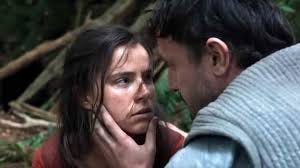
There are writers that can haunt your life from a young age. They skulk around in the background hum of your everyday goings on. Their presence sometimes guides you in times of need. From an introduction to The Merchant of Venice as a teenager in school to subsequently being the teacher attempting to illuminate the beauty of his verse to others, Shakespeare has been a constant in my life. My profession has forged a barely discernible path that leads back to his life and his work. The facts about him are often as hard to find as the path, leaving scholars and admirers alike floundering in a sea of conjecture. The amount we truly know about him is minimal in comparison to what we do not know. He is easy to locate though. Read his words or watch a performance of one of his plays. That is where you will find him: his humanity, his loves, his joys and his grief.
It is for this reason that Hamnet is such a success. It does not attempt to provide the viewer with a window into his life but into his soul. As I write this, I find my attention yet again being drawn to the Great Bard however the film’s central perspective is that of his wife Anne Hathaway, or Agnes as she is named in the film. Shakespeare is not named in the film until close to the end where his name ‘Will’ is finally uttered by Buckley. His great works of literature take a back seat here, focusing instead on the creation and loss of his son Hamnet. The film is a study in grief and what it can do to us.
Based on the novel by Maggie O’Farrell, Hamnet adopts quite an ethereal tone from the start with the striking opening shot of Agnes waking up, foetally curled up in the woods, draped in a red dress, nestled into the roots of a great oak. Her connection with nature and the earth is her life-blood. The perception of the villagers towards Agnes is one of mistrust and fear casting her snidely as a witch’s daughter. Another scene depicting Agnes’ children performing the opening scene of Macbeth for her in the garden further casts a pall of spells, curses and magic over the film. Art commenting on life and life commenting on art.
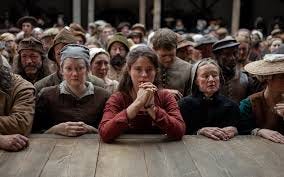
The casting is one of the film’s strengths, with excellent performances from all involved. Emily Watson lends great weight to proceedings as Shakespeare’s mother Mary. Irish actor David Wilmot is also in fine form as the spiteful father of the bard. It is Buckley and Mescal however that inhabit their respective roles with levels of intensity and commitment that is rarely seen on screen. No one knows what the nature of their relationship truly was but this version contains great emotional depth and humanity, two elements that characterised many of his greatest plays and sonnets. Lukasz Zal, whose previous work as cinematographer includes The Zone of Interest (2023), has imbued each scene with a painterly quality reminiscent of the recent Train Dreams (2025). A scene showing Shakespeare on horseback riding across the English countryside in twilight is a perfect example of his brilliance as a cinematographer.
The director Chloe Zhao spoke of adopting an immersive ‘dreamwork’ technique with the actors. Kim Gillingham, a dream coach, was brought on set to guide the actors in meditation sessions as well as recording their dreams in order to bring their unconscious and visceral emotions to the surface. It is easy to be cynical of such methods were the results not wholly evident on the screen. There is an other-wordly quality to Hamnet. It occupies a liminal space in between sleep and consciousness, in between dreams and reality. It is in this space that great art is often created or conceptualised before it is birthed into the world.
London is mostly shown in darkness or near darkness, representing the inner worlds of the two main protagonists. It is only with the introduction of The Globe that we see London bathed in outdoor light - the artistic part of his mind that illuminates the darkness, that allows him to channel the burden of his grief into a transcendent form of high art - Hamlet. The final Globe scene brings all the elements together, much like a potion or elixir: art, grief, love and healing. The redemptive and healing power of art works on two levels here. This benevolent and healing power acts upon the Shakespeares but is amplified out through the screen to the viewer also. It is like a hand reaching across the threshold that separates stage and audience, screen and viewer.
It dissolves the separateness and the disconnection until we merge into a liminal space in a darkened auditorium where we are sharing grief, loss and love. These are universals for all of us and points of commonality that can stitch us back together, regardless of how battered and torn we have become by life. Shakespeare was a seer who was tapped into the main arteries of life. In fourteen lines he could encapsulate a whole existence or an absolute truth. What Hamnet shows us is that there was a life unfurling in Stratford that was as rich, human and textured as his own - that of his wife Agnes.
Beautiful Summation